April 22: Cal Day 2017
Cal Day, an elaborate event of a larger number of fun and educational events that show case the best aspects of UC Berkeley, began at 8:00 am for the staff and volunteers, Peter, Indrase, Thomas, Akshay and Perez of the Center for Energy Efficient Electronics Science (E3S)! As part of the College of Engineering’s open house with lab tours and exhibits, E3S contributed several science and engineering demonstrations aimed at interested students and the general public.
Bright-eyed and bushy-tailed, E3S set-up three different experiment tables — and we were ready for the day!
The most popular table was the one demonstration about magnetism.Groups of families surrounded the table, they learned about ferromagnetism, magneticfields, sensors and motors. 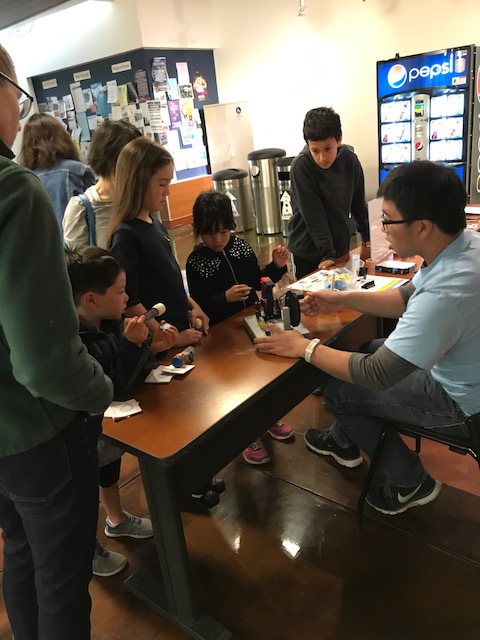 E3S provided several magnets for the ultimate hands on experience.
Electrostatics, also known as static electricity, was the focus of the second table on display. Children would rub plastic bags (charged material) on their cotton clothing (neutral material) and attempted to pull it apart to find the buildup of positive and/or negative charges on the surface of objects an found it would stick.
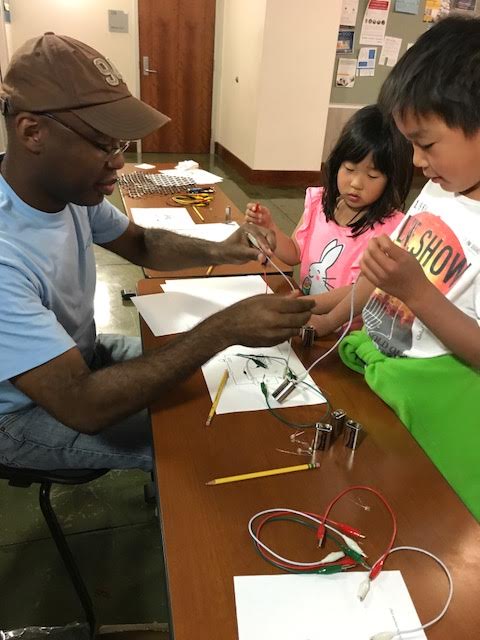
The third table of demonstrations was dedicated to graphene, an exciting new form of carbon. Through posters and conversations with our volunteers, visitors learned that graphene is a two-dimensional atomically-thin honeycomb sheet of carbon. Since graphene is conducting, it can be used to make flexible displays, batteries, sensors, and tiny, energy-efficient chips – the basis of future superfast computers. To demonstrate the electrical conductivity of graphene, visitors used a pencil to draw a thick box on a sheet of paper and shaded it in. The pencil ‘lead’ is actually graphite, which consists of millions of layers of graphene! Visitors were then instructed to touch both ends of the shaded box with two electrical leads — one attached to a light bulb and the other attached to a battery. Upon completing the electrical circuit, the light bulb lit up, showing the shaded graphite box is indeed conducting electricity.

Overall, Cal Day was a huge success! With over 350 visitors and a day full of interested visitors, science experiments, fun, and new faces, the Center for E3S looks forward to next year!